Markets
Orsted shares tumble at the close after U.S. order halts offshore wind leases
By Nordic Tabloid · Copenhagen · Published 22 Dec 2025
The intervention is being justified on national security grounds.
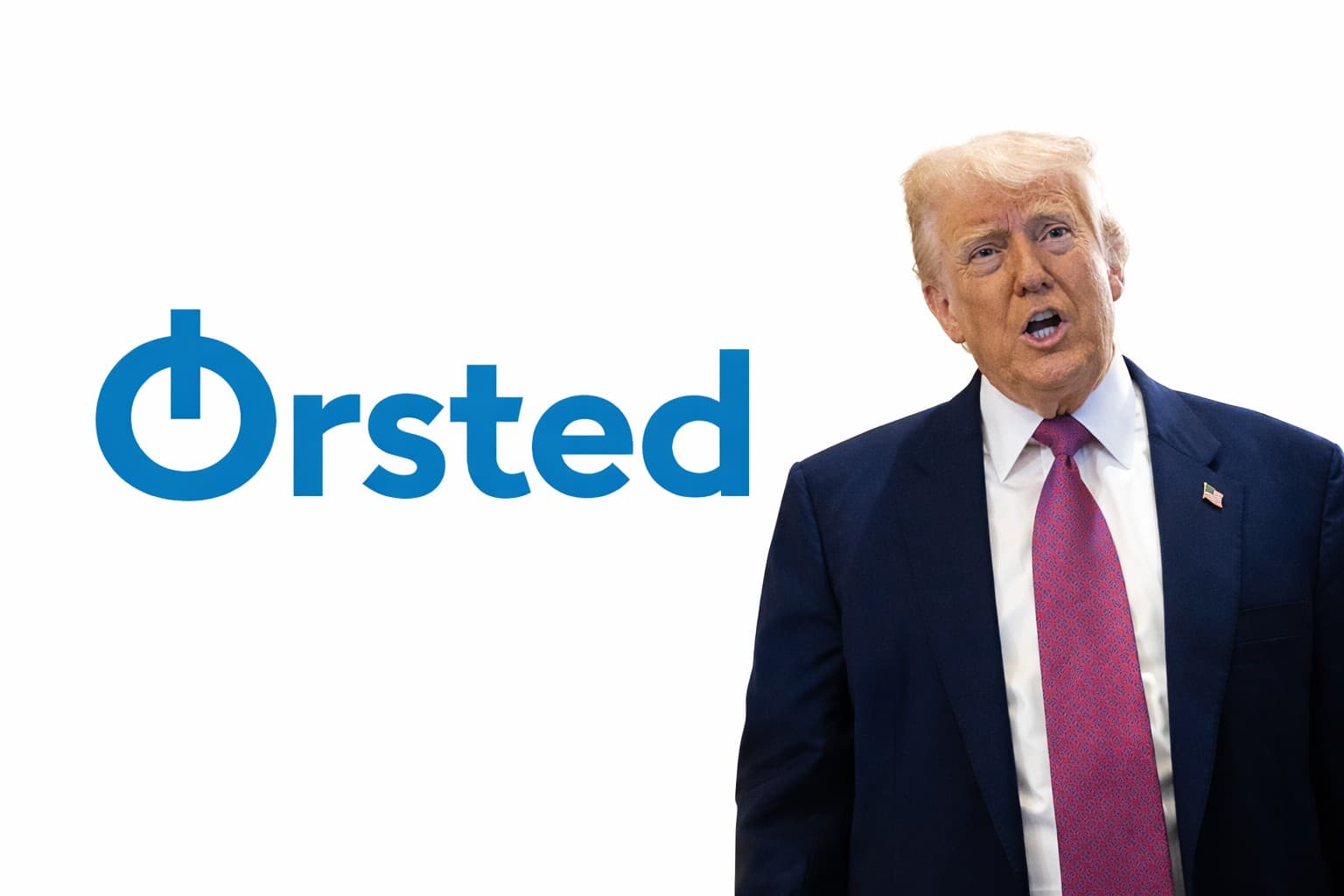
Orsted plunges after U.S. stop order for offshore wind
Orsted’s share price went into free fall on Monday after the U.S. Department of the Interior ordered work to be paused with immediate effect on five major offshore wind projects.
By the close of trading, Orsted was down 12.7 percent.
Vestas was also hit, closing 2.7 percent lower.
The intervention was justified on national security grounds.
U.S. Interior Secretary Doug Burgum said on social media that the pause order is intended to give authorities time—together with the Department of Defense and other relevant public agencies—to assess whether the projects pose security risks and, if so, how those risks can be mitigated.
Part of the argument includes the claim that wind turbines can interfere with radar signals.
Among the affected projects are Orsted’s Revolution Wind and Sunrise Wind, which the company is in the process of building off the U.S. East Coast.
For a company operating with multibillion investments, complex supply chains, and tight installation windows, a stop is not merely a delay—it is costly in its own right.
The market responded immediately by selling the stock sharply lower.
“A declaration of war on offshore wind”
Berlingske business commentator Thomas Bernt Henriksen calls the decision an outright confrontation with the entire offshore wind sector.
“The Trump administration’s decision to pause five major wind projects, including Orsted’s Sunrise Wind and Revolution Wind on the U.S. East Coast, is a declaration of war on offshore wind,” he says.
The pause hits Orsted at a time when the company has already been through a conflict-ridden process specifically over Revolution Wind.
This is the second time in four months that the project—based on the information available—has faced an order to halt work.
This time, the stated reasons are national security and radar considerations.
“It’s harassment,” says Thomas Bernt Henriksen, sharpening his criticism:
Of the DKK 60 billion Orsted has raised in capital, DKK 40 billion is to be used to complete Sunrise Wind.
Simply stopping work is estimated to cost DKK 2 million per day.
And if the pause becomes prolonged or develops into a direct showdown over the projects, the bill could grow dramatically.
At the same time, he directs broader criticism at U.S. regulatory practice, noting that companies that have already gone through extensive approval processes may now find the underlying assumptions shifted from one day to the next.
Equity analyst: “A nightmare scenario”
Sydbank equity analyst Jacob Pedersen calls the situation a nightmare scenario.
“We’ve seen how expensive it was for Orsted to stop Revolution Wind.
Now they also have to stop Sunrise Wind, which they own outright.
So this will be very costly for Orsted here and now,” he says.
He also notes that the stock market lacks answers to the most crucial questions:
How long will the pause last?
What are the consequences for the projects’ future?
Will equipment have to be dismantled or rolled back?
Will there be compensation?
Or is this a temporary administrative move that can be lifted again?
“The answer is just hanging there, blowing in the wind,” says Jacob Pedersen.
He also believes that a worst-case outcome could end up being significantly more expensive than what is immediately reflected in Monday’s share-price drop—while also allowing that the picture could change if the company receives compensation or if the pause proves short-lived.
More projects affected—also CIP and Equinor
The stop order does not only hit Orsted.
Vineyard Wind 1, which is linked to Copenhagen Infrastructure Partners, is also affected.
CIP does not wish to comment on the matter.
In addition, Equinor’s Empire Wind must be halted as a consequence of the order.
The Department of the Interior says the pause is intended to allow time to work with leaseholders and governmental partners to assess and, if necessary, mitigate national security risks.
Doug Burgum maintains that wind turbines pose a security risk and that the primary duty of the U.S. government is to protect the American people.
Legal battles on the horizon
The Trump administration has previously sought to halt offshore wind projects in the United States, including Orsted’s Revolution Wind.
In September, a U.S. judge allowed Orsted to continue work on the offshore wind farm.
Now a stop order has been issued again—this time broader and with immediate effect.
Revolution Wind has announced a lawsuit against the U.S. government, and the states of Rhode Island and Connecticut have followed with their own lawsuits against the administration.
Court filings previously stated that the project had already spent or committed approximately $5 billion and could incur more than $1 billion in wind-down costs if the project were cancelled.
The rights issue and renewed uncertainty
Orsted also launched the largest capital raise in Danish history when the company asked investors for DKK 60 billion.
The company said the amount was sufficient to cushion the impact of the turmoil surrounding the U.S. offshore wind parks on the East Coast.
At the end of September, work resumed, and among equity analysts the expectation was that Orsted could avoid multibillion losses.
Monday’s announcement once again throws the projects into uncertainty—and makes it unclear whether the conflict is about specific security assessments, or whether offshore wind has become a political battleground where decisions can change abruptly.
Equinor: stop, reopening—and political trade-offs
Equinor is also, according to the information, being hit for a second time.
In April, Doug Burgum halted work on Empire Wind off the coast of New York on the grounds that the Biden administration had rushed the project without sufficient analyses.
The decision was reversed a month later after the administration reached an agreement with New York Governor Kathy Hochul to clear the way for new gas pipelines in the state.
That led some analysts to suggest that factors without a direct connection to the energy projects may be influencing outcomes.
At the same time, it is suggested that Orsted’s troubles in the United States may have a broader political backdrop.
Among the explanations mentioned is U.S. interest in Greenland and Denmark’s lack of interest in entering into dialogue about it.
And within the industry, Equinor’s reopening was noted as a project that got back on track after what appeared to be a kind of quid pro quo.

